
Ideal Gas Law Worksheet Pv Nrt Answers
Ideal Gas Law Worksheet Pv Nrt Answers - 1) rearrange pv = nrt to this: Solutions to the ideal gas law practice worksheet: Use your knowledge of the ideal and combined gas laws to solve the following problems. A theoretical gas composed of randomly moving point particles that do not interact except during elastic collisions. 1) if four moles of a gas at a pressure of 5.4. The ideal gas law states that pv = nrt, where p is the pressure of a gas, v is the volume of the gas, n is the number of moles of gas present, r is the ideal gas constant, and t is the.
Pv = nrt model 1: What is the density of laughing gas, dinitrogen monoxide, n 2 o, at a temperature of 325 k and a pressure of 113.0 kpa? T(k) is always ≥ 0 k • boyle’s law (1660). Use your knowledge of the ideal and combined gas laws to solve the following problems. Show your work, including proper units, to earn full credit.
What is the density of laughing gas, dinitrogen monoxide, n 2 o, at a temperature of 325 k and a pressure of 113.0 kpa? If 3.7 moles of propane are at a temperature of. Pv = nrt solving for p. The ideal gas law states that pv = nrt, where p is the pressure of a gas, v is the volume of the gas, n is the number of moles of gas present, r is the ideal gas constant, and t is the.
Ideal Gas Law Worksheet With Answers

1) rearrange pv = nrt to this: A theoretical gas composed of randomly moving point particles that do not interact except during elastic collisions. Ideal gas law using the ideal gas law, pv·nrt calculate the parameter that is missing in each row of the following. If it involves moles or grams, it must be pv = nrt. 1) if four.
Solved Ideal Gas Law Worksheet PV = nRT Use the ideal gas
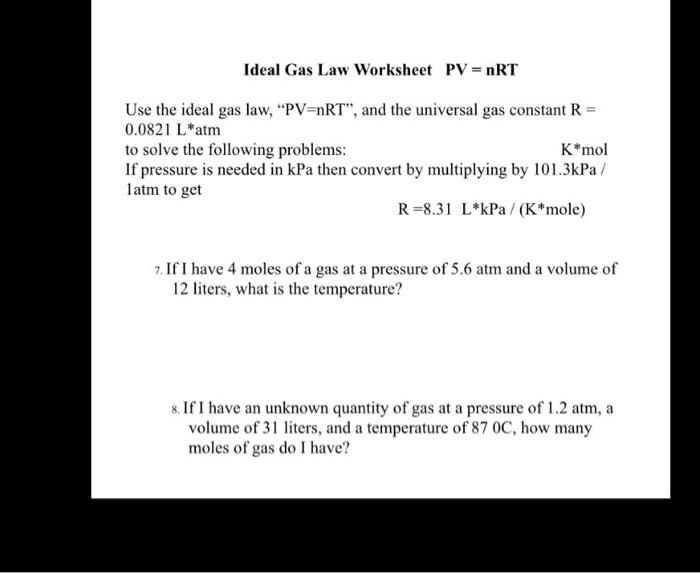
Assume that the lungs are at 1.00 atm pressure and at. If it involves moles or grams, it must be pv = nrt. K*mol if pressure is needed in kpa. Ideal gas law questions are asked. Ideal gas law using the ideal gas law, pv·nrt calculate the parameter that is missing in each row of the following.
Solved For the Ideal Gas law PV = nRT, set nR = 8.3 and

T(k) is always ≥ 0 k • boyle’s law (1660). Determine the volume of occupied by 2.34 grams of carbon dioxide gas at stp. 2) what is the volume of 1.00 mole of a gas at standard temperature and pressure? If 3.7 moles of propane are at a temperature of. Don’t forget that your temp must be in kelvin.
Solved Ideal Gas Law Worksheet PV=nRT 1. What pressure is

V = 1.19 l (to three significant figures) problem #2:. Don’t forget that your temp must be in kelvin. The ideal gas law states that pv=nrt, where p is the pressure of a gas, v is the volume of the gas, n is the number of. Pv = nrt model 1: Pv = nrt solving for p.
Pv Nrt Worksheet With Answers Printable Calendars AT A GLANCE

1) if four moles of a gas at a pressure of 5.4. Solutions to the ideal gas law practice worksheet: The ideal gas law states that pv=nrt, where p is the pressure of a gas, v is the volume of the gas, n is the number of. Assume that the lungs are at 1.00 atm pressure and at. Don’t forget.
Ideal Gas Law Worksheet Pv Nrt

Ideal gas law questions are asked. 1) if four moles of a gas at a pressure of 5.4. The ideal gas law directions: V = 1.19 l (to three significant figures) problem #2:. What is the density of laughing gas, dinitrogen monoxide, n 2 o, at a temperature of 325 k and a pressure of 113.0 kpa?
Ideal Gas Law Worksheet Pv Nrt Answers

Calculate the density of freon 12, cf 2 cl 2, at 30.0. Show your work, including proper units, to earn full credit. The ideal gas law directions: Ideal gas law worksheet pv = nrt use the ideal gas law, pv=nrt”, and the universal gas constant r = 0.0821 l*atm to solve the following problems: 1) rearrange pv = nrt to.
Ideal Gas Law Worksheet Pv Nrt Answers - Pv = nrt model 1: 1) if four moles of a gas at a pressure of 5.4. The ideal gas law states that pv = nrt, where p is the pressure of a gas, v is the volume of the gas, n is the number of moles of gas present, r is the ideal gas constant, and t is the. The ideal gas law directions: Solve each of the following problems. Depending which r value you use, tells you which label to put on your resulting pressure value. When you know four parameters, you can find the unknown parameter in the equation. Use your knowledge of the ideal and combined gas laws to solve the following problems. Solutions to the ideal gas law practice worksheet: Ideal gas law questions are asked.
The ideal gas law states that pv=nrt, where p is the pressure of a gas, v is the volume of the gas, n is the number of. What is the density of laughing gas, dinitrogen monoxide, n 2 o, at a temperature of 325 k and a pressure of 113.0 kpa? Pv = nrt model 1: How many moles of gas (air) are in the lungs of an adult with a lung capacity of 3.9 l? There are five parameters in ideal gas law equation (pv = nrt).
The Ideal Gas Law States That Pv = Nrt, Where P Is The Pressure Of A Gas, V Is The Volume Of The Gas, N Is The Number Of Moles Of Gas Present, R Is The Ideal Gas Constant, And T Is The.
There are five parameters in ideal gas law equation (pv = nrt). Don’t forget that your temp must be in kelvin. Show your work, including proper units, to earn full credit. The ideal gas law states that pv=nrt, where p is the pressure of a gas, v is the volume of the gas, n is the number of.
10 Ideal Gas Law 1.
How many moles of gas (air) are in the lungs of an adult with a lung capacity of 3.9 l? 1) rearrange pv = nrt to this: 1) if four moles of a gas at a pressure of 5.4. A theoretical gas composed of randomly moving point particles that do not interact except during elastic collisions.
V = 1.19 L (To Three Significant Figures) Problem #2:.
Ideal gas law using the ideal gas law, pv·nrt calculate the parameter that is missing in each row of the following. 2) what is the volume of 1.00 mole of a gas at standard temperature and pressure? Ideal gas law worksheet pv = nrt use the ideal gas law, pv=nrt”, and the universal gas constant r = 0.0821 l*atm to solve the following problems: If 3.7 moles of propane are at a temperature of.
1) If Four Moles Of A Gas At A Pressure Of 5.4.
Pv = nrt solving for p. The ideal gas law directions: Apply the ideal gas law: K*mol if pressure is needed in kpa.